


Why Consider Bed-Stay
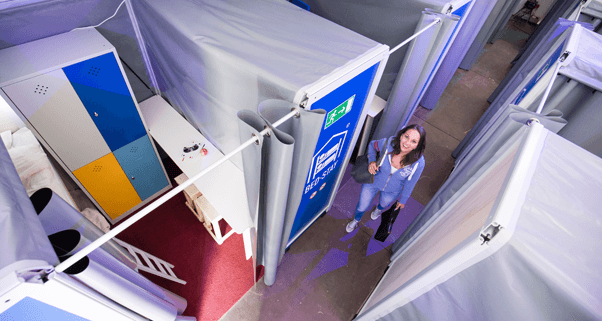
• Create as many comfortable sleeping spaces as you need — effortlessly
• Prioritise your privacy and our planet's sustainability
• Can be fully equipped with mobile charging units, and lockers
• Crucial for a good night's rest, well-being, and peak performance
Events - Shelter - Military
Darkness makes the difference: how blackout curtains create real rest
Darkness makes the difference: how blackout curtains create real rest
Rest does not begin when you lie down. It begins when your brain gets permission to let go. And that moment is much harder to reach when there is light. No matter how faint, no matter how far away. The human brain registers light even during sleep, keeping itself in a state of alertness that noticeably degrades sleep quality.
That might sound abstract. But ask anyone who has worked a multi-day event, slept in emergency accommodation, or operated in military shift rotations. Those people know exactly what it means to try to sleep while the world around them carries on.
What actually happens when light disrupts your sleep
When light reaches your eyes during sleep, even indirectly, the brain sends a signal that suppresses melatonin production. Melatonin is the hormone that puts your body into recovery mode. Without it, you sleep lighter, wake more often, and spend far less time in the deep sleep phases where real restoration happens. You can lie on a mattress for eight hours and still wake up exhausted.
In normal circumstances, you fix that by going home and closing the curtains. But in temporary shelter situations, at festival sites, in military camps, or during disaster response, that option does not exist. Unless someone has thought carefully about the sleep environment they are providing.
Why Bed-Stay made blackout curtains a standard, not an option
Bed-Stay was built on the conviction that sleep cannot be an afterthought in chaotic situations. Quite the opposite. Precisely when everything around someone is uncontrolled, the sleep space needs to offer as much calm as possible. Blackout curtains are part of that from the start, not an upgrade.
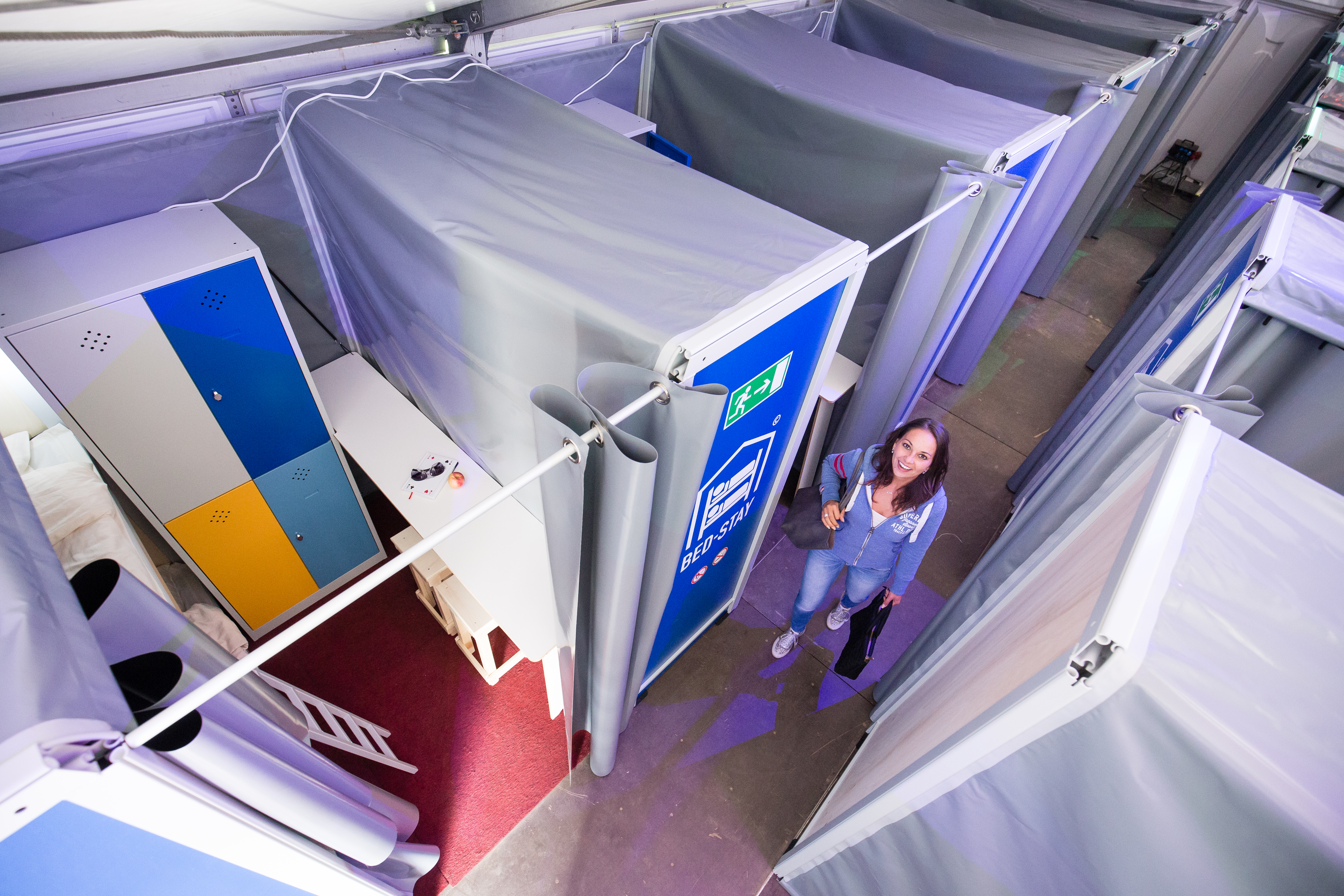
The curtains in our sleep modules significantly reduce both incoming light and ambient noise. They create a darker, quieter environment that the body recognises as a place to sleep, even when there is activity outside, even in the middle of the day, even when the situation is tense. Shutting everything out completely is never fully possible in temporary environments, but reducing the threshold is enough to make a real difference.
The psychology of having your own space
There is something else blackout curtains do that people tend to underestimate: they provide privacy. In a temporary shelter, you are never truly alone. There are always others nearby, always movement, always noise. But a curtain that closes sends a signal: this part is mine.
That feeling carries more weight than you might expect. Research into refugee accommodation and disaster response consistently shows that people function better, stay mentally more stable, and recover faster when they experience even a small degree of personal space. A curtained sleep space is exactly that. Small, temporary, but real.
Designed for the situations that actually matter
The blackout curtains in Bed-Stay modules were not chosen at random. They were selected and specified based on the demands of the environments where our sleep solutions are deployed. They are fire-retardant, easy to clean, quick to fit, and built to handle intensive use.
In situations where speed of setup and breakdown is critical, curtains cannot add friction. In environments where hygiene matters, materials need to be easy to clean. And in contexts where safety is non-negotiable, nothing can introduce additional risk. On every one of those points, the curtains we use reflect a deliberate choice.
We do not sell a bed. We sell calm in chaos.
That is the core of what Bed-Stay does. The blackout curtains are one of the most direct expressions of that philosophy. They are the difference between a bunk in a hall and a sleep space that actually works. For the relief worker who needs to be sharp again tomorrow. For the refugee who has not slept properly in weeks. For the event crew member whose shift starts at six in the morning.
They are small details with significant consequences. Which is exactly why, at Bed-Stay, they are never optional.
Curious about how Bed-Stay sleep solutions work in practice?We are happy to tell you more in a short introductory call.


